Davyd Chychkan
“Minute”, 2025, video, 1″
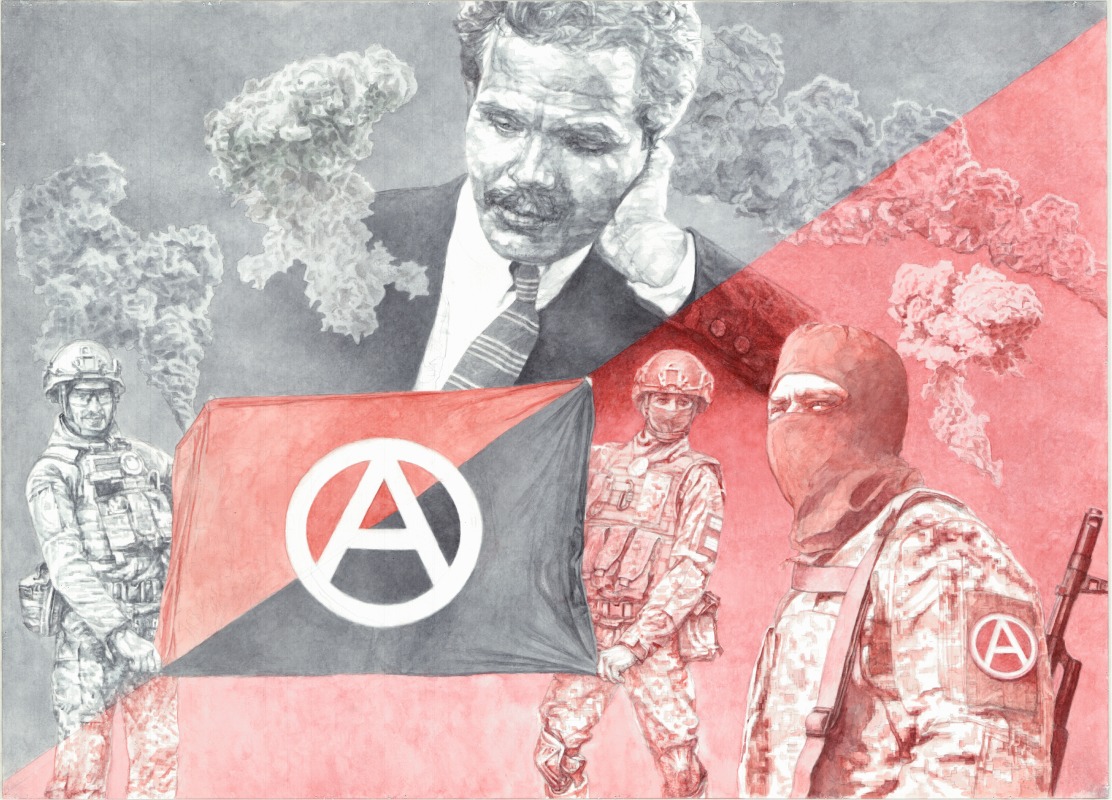
“Anti-Authoritarian Left Armed Forces of Ukraine”, 2023, watercolor drawing, paper, watercolor, 109.8 × 75 cm
“Anti-Authoritarian Left Armed Forces of Ukraine”, 2023, watercolor drawing, paper, watercolor, 50 × 70 cm
Davyd Chychkan, a Ukrainian artist, anarchist, and mortar operator in the ranks of the Armed Forces of Ukraine, died on August 9, 2025, from wounds sustained in battle on the Zaporizhzhia front. Davyd went to war because this decision was an organic expression of his principled critical stance, which he demonstrated both in his art and in his political views. He worked in graphics, painting, poster art, street art, and performance.
Positioning himself as an anarchist, Davyd understood this movement as a critical anti-ideological stance, a permanent revolution of consciousness, and its emancipation. He interpreted anarchism as an integral part of Ukrainian political thought and as a kind of key to the Ukrainian national project. In his creative practice, invoking symbolic figures of Ukrainian history regarded as the founders of Ukrainian national identity—Ivan Franko, Mykhailo Drahomanov, Lesya Ukrainka—Davyd reminded us that the roots of the Ukrainian national idea are interwoven with leftist social thought.
The series of watercolor graphic sheets Anti-Authoritarian Left Armed Forces of Ukraine was created as a tribute to activists of anarchist and anti-authoritarian leftist movements within the ranks of the Armed Forces of Ukraine, the National Guard of Ukraine, and the Main Intelligence Directorate of the Ministry of Defense of Ukraine. In these works, Davyd articulated the diversity of Ukraine’s armed forces and the specificity of Ukrainian subjectivity—particularly as the conscious responsibility of armed people, entrusted with the imperative mandate of defending Ukraine and its people from invaders. He contrasted this diversity with the Russian army of conscripts, where the only possible political position is imperial-fascist.
For the artist, continuity with the national and social projects of the Ukrainian People’s Republic and the Huliai-Pole Republic was essential for modern Ukraine. Davyd sought to define it through the specific symbolism of colors and the political stance of the soldiers he portrayed. The collective portraits are composed of photographs that soldiers either published or sent to the artist. In the shared artistic space of imagination, which also proved political, soldiers who in real life were far apart could find themselves together. Davyd proposed supplementing the national symbolism with colors carrying a social charge and evoking the memory of the origins of Ukraine’s liberation struggle in the early 20th century—adding black, pink, and violet to the blue and yellow, symbolizing anarchist, socialist, and feminist movements.
For the possibility of loving Ukraine as only he could, of shaping it in accordance with his vision and values, Davyd Chychkan went to war. He died defending the right to the existence of a Ukraine where everyone can publicly uphold their views, where the free representation of diversity is possible—ideas still upheld by the European community.